




Blog Details

  • Shivi Tech
  • SEO
  • White Label SEO: What It Is, How It Works and What to Pay

White Label SEO: What It Is, How It Works and What to Pay

White Label SEO Company

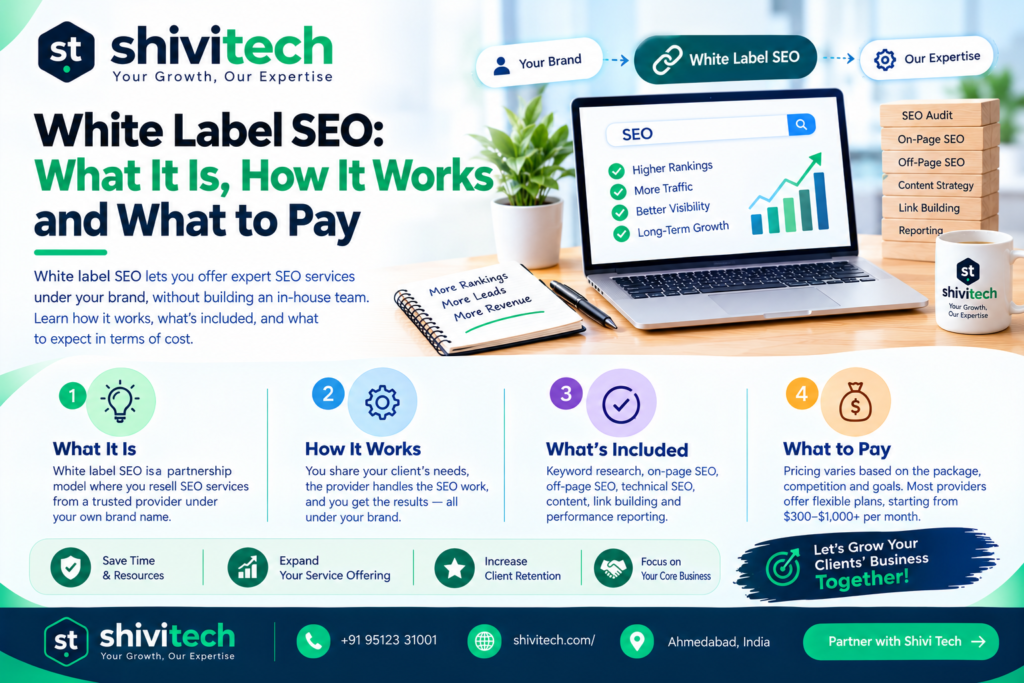
White label SEO is an arrangement where a specialist provider does the SEO work and you sell it to your clients under your own brand. The client sees your agency, your reports and your name; the provider stays behind the scenes. It suits web design, PPC, social and marketing agencies that want to add SEO without hiring a full in-house team. Costs usually run as a monthly retainer or per-project fee, with your margin added on top. The one risk to check first is report quality, because your client will judge you on it. This guide covers what you can resell, how an engagement runs, pricing, red flags and when to avoid it.

What Is White Label SEO?

In plain terms, white label SEO means outsourcing delivery while keeping the client relationship. You sell the service, set the price and own the conversation. The provider handles audits, optimisation, content support, link work and reporting, and hands you client-ready deliverables with no mention of their name. Searches for “SEO reseller” and “private label SEO” describe the same idea.

It works because SEO is time-consuming and specialised. Hiring an experienced strategist, a technical SEO and a content team is expensive for a small agency, particularly when client numbers rise and fall. A white label partner lets you add capacity as you win work.

White label vs. freelancers vs. subcontracting

These get confused, so here’s the difference:

  • Freelancers are individuals you hire directly. They can be excellent, but you depend on one person’s availability, and their process and reporting vary.
  • Subcontracting is a general term for handing work to another business, often project by project, and the subcontractor may deal with your client directly.
  • White label SEO is a defined, ongoing service, with processes, reporting and communication built so the provider stays invisible to your client.

Private label is often used interchangeably. Some people use it for a ready-made product you rebrand, and white label for a service delivered to your specification. In SEO, the two are usually treated as the same thing.

What Gets Resold in White Label SEO?

A good provider covers the main parts of an SEO campaign. Agree upfront which are included in your plan.

Technical and on-page SEO

This is the foundation. It typically includes:

  • Technical audits covering crawlability, indexing, site speed, mobile usability and structured data
  • Keyword research and mapping to pages
  • On-page work such as titles, meta descriptions, headings, internal links and image optimisation
  • Fixes or clear instructions for your developers
  • Google Business Profile setup and optimisation for local clients

Tools commonly used include Google Search Console for performance and indexing data, and platforms such as Ahrefs or Semrush for research and tracking.

Content, links and reporting

  • Content: briefs, blog posts, service pages and refreshes of older content
  • Link building: outreach, digital PR and citations, done in line with Google’s guidelines
  • Reporting: monthly reports your client can understand, often built in Looker Studio or similar dashboards, with your branding

Reporting deserves special attention. Your client doesn’t see the work. They see the report. A clear report that ties activity to outcomes is what keeps clients renewing.

How Does a White Label SEO Engagement Run, Week by Week?

Workflows differ between providers, but a typical first month looks like this:

  1. Week 1: Onboarding. You share the client’s goals, access to Search Console and analytics, and any brand guidelines. The provider confirms scope and communication channels.
  2. Week 2: Audit and research. The provider runs a technical audit, reviews competitors and researches keywords.
  3. Week 3: Strategy and roadmap. You receive a prioritised plan, which you can present to the client under your brand.
  4. Week 4: First fixes and reporting. Quick wins go live, content is scheduled and your first report is prepared.
  5. Ongoing: monthly cycles of optimisation, content, link work, tracking and reporting, with regular check-ins.

The handoff is where things go wrong most often, so agree turnaround times and who approves what before work begins.

What Are the Pricing Models and What Should You Pay?

White label SEO is priced in a few common ways. Prices vary widely by provider, market and scope, so treat any figures you see online as rough guides and ask for itemised quotes.

Per-project, retainer and per-deliverable

Model How it works Best for
Per-project A fixed fee for a defined piece of work, such as an audit or a site migration One-off needs and testing a provider
Monthly retainer A recurring fee for ongoing work at an agreed scope Most ongoing client campaigns
Per-deliverable A set price for each item, such as a blog post or a batch of citations Agencies with variable volumes

Retainers are the most common because SEO is cumulative. Pay attention to what’s included: hours, deliverables, reporting and revisions.

Typical margin

You set your client price, and your margin is the difference between that and what you pay the provider. Many agencies aim for a healthy mark-up to cover account management, reporting time and the risk they carry, but the right figure depends on your costs and market. Work it out per client, including your own time, before you quote. A price that’s too low to cover your overheads makes the service hard to sustain.

Beware choosing on price alone. Very cheap packages often rely on shortcuts such as bulk low-quality links or templated content, which can put your client’s site at risk.

What Are the Red Flags in a White Label SEO Provider?

  • Guaranteed rankings. No one can guarantee a position on Google.
  • Vague answers about link sources. If they can’t explain where links come from, be cautious. Google’s spam policies describe link schemes and other practices that can lead to penalties.
  • No sample reports or reports that are just exported tool screenshots.
  • Secrecy about the process, or no named contact.
  • Unrealistic speed, such as promising page-one results in weeks.
  • No NDA or unclear ownership of accounts and data.
  • Poor communication, with slow replies or no agreed hours.
  • Everything is automated, with no strategy tailored to the client.

A reputable provider will be happy to explain their methods and show examples.

What Should You Ask Before Signing?

Reporting sample, NDA, link sources, communication hours

Before you commit, ask:

  • Can I see a sample report? Check that it’s clear, branded and meaningful to a non-expert. Request one with client data blurred.
  • Will you sign an NDA? Your client relationships and data should be protected.
  • Where do your links come from? Look for specific, white-hat answers about outreach and content-led links.
  • Who owns the accounts and data? Search Console, analytics and ad accounts should belong to your client or your agency.
  • What are your communication hours and response times? This matters if you’re in a different time zone.
  • What’s the contract length and how do I exit? Look for flexible terms and a clear notice period.
  • What happens if a client is unhappy? Ask how they handle escalations.
  • Who will actually do the work? Know whether it’s in-house or passed on again.

About Shivi Tech. We’re an Ahmedabad-based team that delivers SEO for agencies in the UK, US and Australia. If you’re evaluating providers, you can review our white label SEO services and compare them against this checklist.

When Is White Label SEO the Wrong Choice?

It isn’t right for every agency. Think twice if:

  • You want to learn SEO in depth. Outsourcing delivery can slow your own skill-building.
  • Your clients expect to speak to the person doing the work. A middle layer can frustrate them.
  • You can’t price it profitably. Thin margins make the service stressful.
  • You have very few SEO clients. Setup and management time may outweigh the benefit.
  • You can’t give clear briefs. Outsourcing amplifies unclear instructions.
  • Quality control matters more than scale. If you need to review every piece of work, build the capacity in-house.

For agencies that want to understand the full workflow before deciding, our full SEO process is a good starting point. You may also find our other guides on this topic useful: Blog 2 and Blog 3.

FAQs

Is it legal to resell SEO?

Yes. Reselling services under your own brand is a common business practice. Make sure your contracts cover confidentiality and that your provider follows Google’s guidelines.

Will clients know I’m outsourcing?

Not unless you tell them. Reports and communication carry your brand. Some agencies are open about using partners, and that’s your choice. Be honest if a client asks directly.

Who owns the accounts?

Ideally your client, or your agency on their behalf. Accounts such as Search Console, analytics and Google Business Profile shouldn’t belong to the provider. Agree this in writing.

Can I see sample reports?

You should be able to. Ask for a real report with client data blurred. If a provider refuses, treat that as a warning sign.

What contract length is normal?

Many providers work month-to-month or on three- to six-month terms, since SEO takes time to show results. Check the notice period and what happens to work in progress if you leave.

How do I handle a client complaint?

Acknowledge it quickly, find out what’s behind it using data, and involve your provider early. Agree an escalation process upfront, so you can respond with facts and a plan.

Conclusion

White label SEO can help an agency add a profitable service without building a team from scratch, provided you choose carefully. Focus on report quality, transparent methods, clear ownership and communication, and price it so your margin holds up. Avoid anyone promising guaranteed rankings.

If you’d like to see how reporting and delivery look in practice, request a sample white label report from Shivi Tech.


Get In Touch

    White Label SEO Company

    White label SEO is an arrangement where a specialist provider does the SEO work and you sell it to your clients under your own brand. The client sees your agency, your reports and your name; the provider stays behind the scenes. It suits web design, PPC, social and marketing agencies that want to add SEO without hiring a full in-house team. Costs usually run as a monthly retainer or per-project fee, with your margin added on top. The one risk to check first is report quality, because your client will judge you on it. This guide covers what you can resell, how an engagement runs, pricing, red flags and when to avoid it.

    What Is White Label SEO?

    In plain terms, white label SEO means outsourcing delivery while keeping the client relationship. You sell the service, set the price and own the conversation. The provider handles audits, optimisation, content support, link work and reporting, and hands you client-ready deliverables with no mention of their name. Searches for “SEO reseller” and “private label SEO” describe the same idea.

    It works because SEO is time-consuming and specialised. Hiring an experienced strategist, a technical SEO and a content team is expensive for a small agency, particularly when client numbers rise and fall. A white label partner lets you add capacity as you win work.

    White label vs. freelancers vs. subcontracting

    These get confused, so here’s the difference:

    • Freelancers are individuals you hire directly. They can be excellent, but you depend on one person’s availability, and their process and reporting vary.
    • Subcontracting is a general term for handing work to another business, often project by project, and the subcontractor may deal with your client directly.
    • White label SEO is a defined, ongoing service, with processes, reporting and communication built so the provider stays invisible to your client.

    Private label is often used interchangeably. Some people use it for a ready-made product you rebrand, and white label for a service delivered to your specification. In SEO, the two are usually treated as the same thing.

    What Gets Resold in White Label SEO?

    A good provider covers the main parts of an SEO campaign. Agree upfront which are included in your plan.

    Technical and on-page SEO

    This is the foundation. It typically includes:

    • Technical audits covering crawlability, indexing, site speed, mobile usability and structured data
    • Keyword research and mapping to pages
    • On-page work such as titles, meta descriptions, headings, internal links and image optimisation
    • Fixes or clear instructions for your developers
    • Google Business Profile setup and optimisation for local clients

    Tools commonly used include Google Search Console for performance and indexing data, and platforms such as Ahrefs or Semrush for research and tracking.

    Content, links and reporting

    • Content: briefs, blog posts, service pages and refreshes of older content
    • Link building: outreach, digital PR and citations, done in line with Google’s guidelines
    • Reporting: monthly reports your client can understand, often built in Looker Studio or similar dashboards, with your branding

    Reporting deserves special attention. Your client doesn’t see the work. They see the report. A clear report that ties activity to outcomes is what keeps clients renewing.

    How Does a White Label SEO Engagement Run, Week by Week?

    Workflows differ between providers, but a typical first month looks like this:

    1. Week 1: Onboarding. You share the client’s goals, access to Search Console and analytics, and any brand guidelines. The provider confirms scope and communication channels.
    2. Week 2: Audit and research. The provider runs a technical audit, reviews competitors and researches keywords.
    3. Week 3: Strategy and roadmap. You receive a prioritised plan, which you can present to the client under your brand.
    4. Week 4: First fixes and reporting. Quick wins go live, content is scheduled and your first report is prepared.
    5. Ongoing: monthly cycles of optimisation, content, link work, tracking and reporting, with regular check-ins.

    The handoff is where things go wrong most often, so agree turnaround times and who approves what before work begins.

    What Are the Pricing Models and What Should You Pay?

    White label SEO is priced in a few common ways. Prices vary widely by provider, market and scope, so treat any figures you see online as rough guides and ask for itemised quotes.

    Per-project, retainer and per-deliverable

    Model How it works Best for
    Per-project A fixed fee for a defined piece of work, such as an audit or a site migration One-off needs and testing a provider
    Monthly retainer A recurring fee for ongoing work at an agreed scope Most ongoing client campaigns
    Per-deliverable A set price for each item, such as a blog post or a batch of citations Agencies with variable volumes

    Retainers are the most common because SEO is cumulative. Pay attention to what’s included: hours, deliverables, reporting and revisions.

    Typical margin

    You set your client price, and your margin is the difference between that and what you pay the provider. Many agencies aim for a healthy mark-up to cover account management, reporting time and the risk they carry, but the right figure depends on your costs and market. Work it out per client, including your own time, before you quote. A price that’s too low to cover your overheads makes the service hard to sustain.

    Beware choosing on price alone. Very cheap packages often rely on shortcuts such as bulk low-quality links or templated content, which can put your client’s site at risk.

    What Are the Red Flags in a White Label SEO Provider?

    • Guaranteed rankings. No one can guarantee a position on Google.
    • Vague answers about link sources. If they can’t explain where links come from, be cautious. Google’s spam policies describe link schemes and other practices that can lead to penalties.
    • No sample reports or reports that are just exported tool screenshots.
    • Secrecy about the process, or no named contact.
    • Unrealistic speed, such as promising page-one results in weeks.
    • No NDA or unclear ownership of accounts and data.
    • Poor communication, with slow replies or no agreed hours.
    • Everything is automated, with no strategy tailored to the client.

    A reputable provider will be happy to explain their methods and show examples.

    What Should You Ask Before Signing?

    Reporting sample, NDA, link sources, communication hours

    Before you commit, ask:

    • Can I see a sample report? Check that it’s clear, branded and meaningful to a non-expert. Request one with client data blurred.
    • Will you sign an NDA? Your client relationships and data should be protected.
    • Where do your links come from? Look for specific, white-hat answers about outreach and content-led links.
    • Who owns the accounts and data? Search Console, analytics and ad accounts should belong to your client or your agency.
    • What are your communication hours and response times? This matters if you’re in a different time zone.
    • What’s the contract length and how do I exit? Look for flexible terms and a clear notice period.
    • What happens if a client is unhappy? Ask how they handle escalations.
    • Who will actually do the work? Know whether it’s in-house or passed on again.

    About Shivi Tech. We’re an Ahmedabad-based team that delivers SEO for agencies in the UK, US and Australia. If you’re evaluating providers, you can review our white label SEO services and compare them against this checklist.

    When Is White Label SEO the Wrong Choice?

    It isn’t right for every agency. Think twice if:

    • You want to learn SEO in depth. Outsourcing delivery can slow your own skill-building.
    • Your clients expect to speak to the person doing the work. A middle layer can frustrate them.
    • You can’t price it profitably. Thin margins make the service stressful.
    • You have very few SEO clients. Setup and management time may outweigh the benefit.
    • You can’t give clear briefs. Outsourcing amplifies unclear instructions.
    • Quality control matters more than scale. If you need to review every piece of work, build the capacity in-house.

    For agencies that want to understand the full workflow before deciding, our full SEO process is a good starting point. You may also find our other guides on this topic useful: Blog 2 and Blog 3.

    FAQs

    Is it legal to resell SEO?

    Yes. Reselling services under your own brand is a common business practice. Make sure your contracts cover confidentiality and that your provider follows Google’s guidelines.

    Will clients know I’m outsourcing?

    Not unless you tell them. Reports and communication carry your brand. Some agencies are open about using partners, and that’s your choice. Be honest if a client asks directly.

    Who owns the accounts?

    Ideally your client, or your agency on their behalf. Accounts such as Search Console, analytics and Google Business Profile shouldn’t belong to the provider. Agree this in writing.

    Can I see sample reports?

    You should be able to. Ask for a real report with client data blurred. If a provider refuses, treat that as a warning sign.

    What contract length is normal?

    Many providers work month-to-month or on three- to six-month terms, since SEO takes time to show results. Check the notice period and what happens to work in progress if you leave.

    How do I handle a client complaint?

    Acknowledge it quickly, find out what’s behind it using data, and involve your provider early. Agree an escalation process upfront, so you can respond with facts and a plan.

    Conclusion

    White label SEO can help an agency add a profitable service without building a team from scratch, provided you choose carefully. Focus on report quality, transparent methods, clear ownership and communication, and price it so your margin holds up. Avoid anyone promising guaranteed rankings.

    If you’d like to see how reporting and delivery look in practice, request a sample white label report from Shivi Tech.


    Get In Touch