




Blog Details

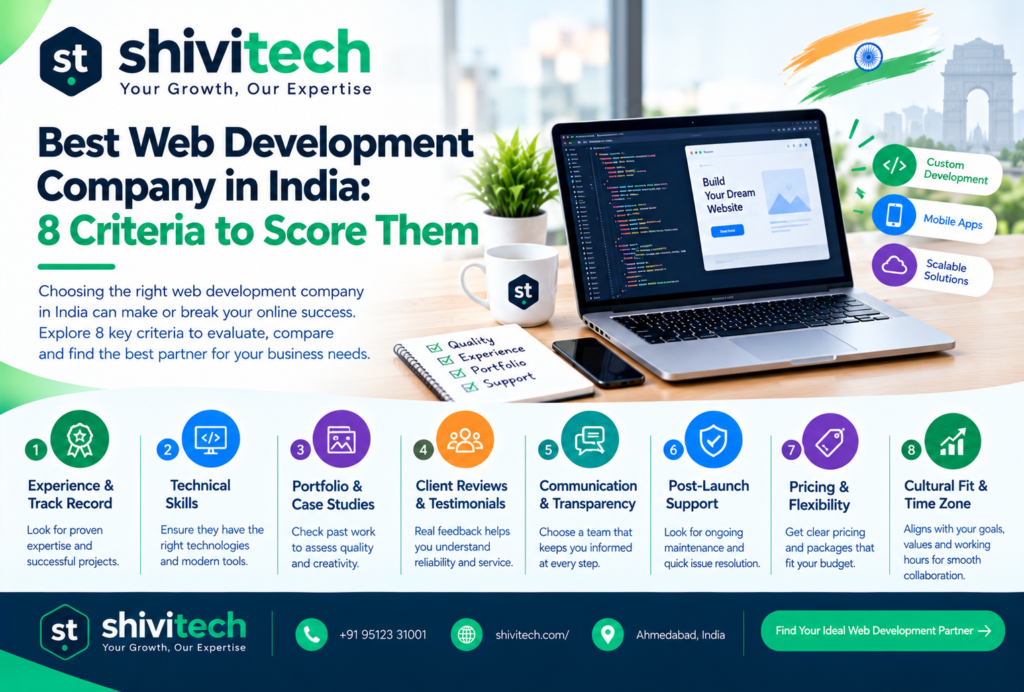
Best Web Development Company in India: 8 Criteria to Score Them

Home / Website Development / Best Web Development Company in India: 8 Criteria to Score Them

Why “best” depends on your project

A company that is excellent for a 10-page brochure site may be wrong for a store with thousands of products. “Best” only means something once you know your goal, platform, budget range and launch date. Write these down before you talk to anyone, and share the same brief with every company so the proposals are comparable.

If you are still deciding between a custom build and a template-based one, read our existing guide, How to Choose a Custom Web Development Company. Once you have a shortlist, return here and score it. Every number you give a company should come from evidence, not impressions.

Criterion 1: Portfolio fit

A portfolio should show work similar to yours, not just attractive screenshots. Look for the same business type, a comparable site size and the same kind of functionality, such as bookings, payments or product catalogues. Ask what the company built, what the client needed and what changed afterwards.

A good portfolio explains the problem, the approach and the outcome. You can see examples of our projects on our work page. Score high when you find a close match and clear case studies, and low when the examples are unrelated or unexplained.

Criterion 2: Tech match

The platform should suit the project, not the team’s habits. WordPress often suits content-led sites, Shopify suits many online stores, and custom code suits unusual requirements. Ask why the company recommends its stack and what that means for hosting, speed and future changes.

Be wary of a company that proposes the same technology for every client. Ask who will maintain the site in two years, and whether your own team could manage it. Score high when the recommendation is explained in terms of your needs.

Criterion 3: Pricing clarity

You are not looking for the cheapest quote. You are looking for a quote you can understand. A clear proposal separates design, development, content, integrations, testing and hosting, and says what is not included. Ask what happens to the price if the scope changes mid-project.

Hidden extras are the main risk, so ask which items usually cost more later. Score high when each line item is explained and change requests have a stated process.

Criterion 4: Process

A reliable company can describe its steps: discovery, design, build, testing, launch and handover. Ask for a sample timeline with milestones and approval points. Find out when you will see designs, when you will see a working version and who signs off at each stage.

Ask what the team does when a project slips. Our related guide, BLOG 4 TITLE, covers this stage in more detail. Score high when the process is specific and has defined review points.

Criterion 5: Communication

Poor communication causes more project trouble than poor code. Ask who your single point of contact is, how often you will get updates and which channel the team uses. Check how quickly and clearly they answered your questions before you signed anything, because that is usually a preview.

Time zones and language are rarely problems for Indian companies serving Indian clients, but response habits still vary. Score high when roles, update schedules and escalation paths are written down.

Criterion 6: Post-launch support

A website needs updates, security patches, backups and fixes after it goes live. Ask what is covered after launch, for how long and at what cost. Find out whether there is a warranty period for bugs, and how fast the company responds when something breaks.

Many buyers focus on launch day and forget the years that follow. Score high when support terms are in writing, with defined response expectations and a clear price for ongoing maintenance.

Criterion 7: References

Evidence from other clients is worth more than any sales pitch. Review platforms such as Clutch and GoodFirms show client reviews and project details, and Google reviews can show how a company treats clients day to day. DesignRush is another directory many buyers check.

Read the reviews themselves rather than the headline rating, and ask for two or three references you can call. Score high when reviews are specific, recent and consistent with what the company tells you.

Criterion 8: Security and ownership

Ask who owns the code, design files, domain, hosting accounts and content after the project ends. You should hold the admin access and the source files. Ask how the company handles backups, updates, user data and payment security.

Unclear ownership can trap you with one vendor. Put the answers in the contract. Score high when ownership transfers to you on payment and security practices are explained plainly.

A scoring sheet you can copy

Give each company the same brief, then score every criterion from 1 (weak) to 5 (strong). Weight the criteria that matter most to your project, multiply, and compare totals. Treat any score of 1 on security and ownership as a reason to pause.

Criterion Weight (1-3) Company A Company B Company C
1. Portfolio fit        
2. Tech match        
3. Pricing clarity        
4. Process        
5. Communication        
6. Post-launch support        
7. References        
8. Security and ownership        
Weighted total        

Frequently asked questions

How many companies should I shortlist?

Three to five is practical. Fewer limits comparison, and more makes it hard to give each one a fair, detailed review.

Should I trust directory rankings?

Use them to find candidates, not to pick a winner. Check how a directory orders its listings, whether sponsored placements exist, and read the reviews themselves.

What do reference calls reveal?

They show how a company behaves when plans change: whether deadlines held, how problems were handled and whether the client would hire them again.

How long do projects take?

It depends on scope, content readiness and approval speed. Ask for a milestone timeline in the proposal rather than a single launch date.

What should the proposal include?

Scope, deliverables, platform and reasons, timeline, itemized pricing, exclusions, support terms and ownership of all assets.

Ready to compare? Send us your brief, and we will show you how a web development company in India that is open to scoring should answer. Request a proposal and score us.

Get In Touch

    Why “best” depends on your project

    A company that is excellent for a 10-page brochure site may be wrong for a store with thousands of products. “Best” only means something once you know your goal, platform, budget range and launch date. Write these down before you talk to anyone, and share the same brief with every company so the proposals are comparable.

    If you are still deciding between a custom build and a template-based one, read our existing guide, How to Choose a Custom Web Development Company. Once you have a shortlist, return here and score it. Every number you give a company should come from evidence, not impressions.

    Criterion 1: Portfolio fit

    A portfolio should show work similar to yours, not just attractive screenshots. Look for the same business type, a comparable site size and the same kind of functionality, such as bookings, payments or product catalogues. Ask what the company built, what the client needed and what changed afterwards.

    A good portfolio explains the problem, the approach and the outcome. You can see examples of our projects on our work page. Score high when you find a close match and clear case studies, and low when the examples are unrelated or unexplained.

    Criterion 2: Tech match

    The platform should suit the project, not the team’s habits. WordPress often suits content-led sites, Shopify suits many online stores, and custom code suits unusual requirements. Ask why the company recommends its stack and what that means for hosting, speed and future changes.

    Be wary of a company that proposes the same technology for every client. Ask who will maintain the site in two years, and whether your own team could manage it. Score high when the recommendation is explained in terms of your needs.

    Criterion 3: Pricing clarity

    You are not looking for the cheapest quote. You are looking for a quote you can understand. A clear proposal separates design, development, content, integrations, testing and hosting, and says what is not included. Ask what happens to the price if the scope changes mid-project.

    Hidden extras are the main risk, so ask which items usually cost more later. Score high when each line item is explained and change requests have a stated process.

    Criterion 4: Process

    A reliable company can describe its steps: discovery, design, build, testing, launch and handover. Ask for a sample timeline with milestones and approval points. Find out when you will see designs, when you will see a working version and who signs off at each stage.

    Ask what the team does when a project slips. Our related guide, BLOG 4 TITLE, covers this stage in more detail. Score high when the process is specific and has defined review points.

    Criterion 5: Communication

    Poor communication causes more project trouble than poor code. Ask who your single point of contact is, how often you will get updates and which channel the team uses. Check how quickly and clearly they answered your questions before you signed anything, because that is usually a preview.

    Time zones and language are rarely problems for Indian companies serving Indian clients, but response habits still vary. Score high when roles, update schedules and escalation paths are written down.

    Criterion 6: Post-launch support

    A website needs updates, security patches, backups and fixes after it goes live. Ask what is covered after launch, for how long and at what cost. Find out whether there is a warranty period for bugs, and how fast the company responds when something breaks.

    Many buyers focus on launch day and forget the years that follow. Score high when support terms are in writing, with defined response expectations and a clear price for ongoing maintenance.

    Criterion 7: References

    Evidence from other clients is worth more than any sales pitch. Review platforms such as Clutch and GoodFirms show client reviews and project details, and Google reviews can show how a company treats clients day to day. DesignRush is another directory many buyers check.

    Read the reviews themselves rather than the headline rating, and ask for two or three references you can call. Score high when reviews are specific, recent and consistent with what the company tells you.

    Criterion 8: Security and ownership

    Ask who owns the code, design files, domain, hosting accounts and content after the project ends. You should hold the admin access and the source files. Ask how the company handles backups, updates, user data and payment security.

    Unclear ownership can trap you with one vendor. Put the answers in the contract. Score high when ownership transfers to you on payment and security practices are explained plainly.

    A scoring sheet you can copy

    Give each company the same brief, then score every criterion from 1 (weak) to 5 (strong). Weight the criteria that matter most to your project, multiply, and compare totals. Treat any score of 1 on security and ownership as a reason to pause.

    Criterion Weight (1-3) Company A Company B Company C
    1. Portfolio fit        
    2. Tech match        
    3. Pricing clarity        
    4. Process        
    5. Communication        
    6. Post-launch support        
    7. References        
    8. Security and ownership        
    Weighted total        

    Frequently asked questions

    How many companies should I shortlist?

    Three to five is practical. Fewer limits comparison, and more makes it hard to give each one a fair, detailed review.

    Should I trust directory rankings?

    Use them to find candidates, not to pick a winner. Check how a directory orders its listings, whether sponsored placements exist, and read the reviews themselves.

    What do reference calls reveal?

    They show how a company behaves when plans change: whether deadlines held, how problems were handled and whether the client would hire them again.

    How long do projects take?

    It depends on scope, content readiness and approval speed. Ask for a milestone timeline in the proposal rather than a single launch date.

    What should the proposal include?

    Scope, deliverables, platform and reasons, timeline, itemized pricing, exclusions, support terms and ownership of all assets.

    Ready to compare? Send us your brief, and we will show you how a web development company in India that is open to scoring should answer. Request a proposal and score us.

    Get In Touch