

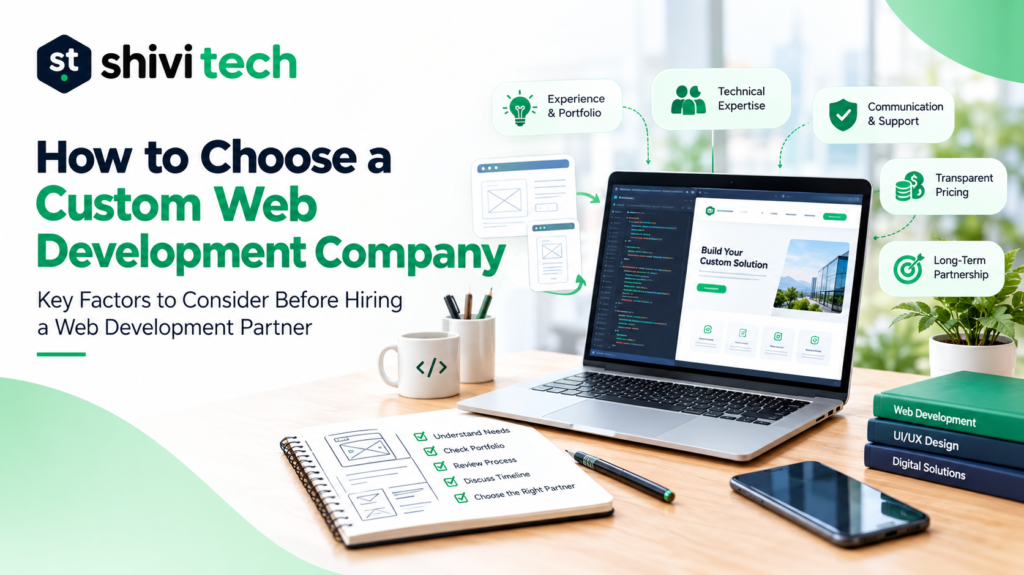
Hiring the wrong development partner is expensive twice over: once for the build, and again when you have to rebuild it. If you’re evaluating vendors right now, you’re probably past the “what is this” stage and into “how do I not get burned.” Here’s what actually separates a real custom web development company from a template shop with a nicer sales pitch — and the questions that expose the difference before you sign anything.
What Is a Custom Web Development Company?
A custom web development company designs and builds websites from the ground up around a business’s specific workflows, data, and goals, rather than adapting a pre-built theme or drag-and-drop template to fit. The output is code built for one client’s requirements, not a shared template with a new logo dropped on top.
This is different from three other options people often lump together:
- A freelancer typically works alone, on your timeline and theirs, with limited capacity for testing, documentation, or long-term support.
- A website builder (Wix, Squarespace, and similar tools) gives you a fixed set of design and functionality choices — fine for simple sites, limiting once your business logic gets specific.
- A template agency installs and customizes an existing theme, usually on WordPress, which is faster and cheaper but caps how far the site can flex before it breaks.
A custom development company sits above all three: a team, a process, and code that’s built to fit your business rather than the other way around.
Signs You Need Custom Development Instead of a Template or Builder
Not every business needs a fully custom build. These are the situations where a template genuinely starts to work against you.
Your business logic doesn’t fit a page builder
If your site needs to do something specific — a custom quoting tool, a member portal with tiered access, an integration between your CMS and internal systems — a builder or theme will force you to bolt on plugins and workarounds. Each workaround adds a point of failure. Custom development lets that logic be built in from the start.
You’re hitting performance or scalability ceilings
Template sites and page builders carry a lot of code you don’t use, which slows load times and hurts Core Web Vitals. If your traffic, catalog size, or transaction volume is growing, a template built for a generic use case will start to show cracks — slower pages, plugin conflicts, hosting limitations.
Design and brand differentiation are competitive advantages in your market
In crowded markets, a site that looks like a dozen competitors’ sites (because they’re all running the same theme) doesn’t help you stand out. Custom UX/UI design gives you a look and an interaction pattern nobody else has, which matters more in some industries than others.
If none of these apply to you yet, a well-built template site may genuinely be the smarter spend. If one or more do, custom development starts to pay for itself.
Custom Website vs Template: A Side-by-Side Comparison
| Factor | Custom-Coded Website | Template / Page Builder |
| Upfront cost | Higher | Lower |
| Time to launch | Longer (weeks to months) | Shorter (days to weeks) |
| Flexibility | Built around your exact workflows | Limited to the builder’s or theme’s features |
| Performance | Optimized for only what you need | Often carries unused code and plugin bloat |
| Scalability | Built to grow with traffic and complexity | Can hit hard limits as the business grows |
| Maintenance | Requires a dev relationship or in-house resource | Often self-serviceable |
| SEO control | Full control over site architecture and technical SEO | Constrained by the platform’s structure |
| Code ownership | Typically yours outright | Often tied to the platform or builder account |
The right answer depends on where your business is today, not where it might be in five years. A template can be the right call for an early-stage site with simple needs; custom development earns its cost once complexity, scale, or differentiation start to matter.
What a Custom Web Development Process Actually Looks Like
A legitimate development partner will walk you through a defined process before writing a line of code. Here’s the shape it should take.
Discovery and requirements
This phase maps out what the site actually needs to do — user flows, integrations, content structure, business goals — before any design work starts. If a company skips this and jumps straight to mockups, that’s a signal they’re customizing a template rather than building from requirements.
Architecture and platform selection (WordPress, Webflow, or fully custom)
Not every custom project means custom code from scratch. A good partner will recommend the right foundation for your specific needs — WordPress development for content-heavy sites that need a flexible CMS, Webflow for design-forward sites with visual editing needs, or a fully custom-coded build for complex applications and business logic. The platform decision should follow from your requirements, not from what the agency is most comfortable selling.
Build, QA, and launch
The build phase includes development, internal testing, and client review cycles, followed by quality assurance across devices and browsers before launch. A rushed or skipped QA phase is one of the most common sources of post-launch bugs and client frustration.
At Shivi Tech, this shows up as a straightforward framework: discovery, planning, design, build, test, launch — each phase gated by client sign-off before moving to the next, so there are no surprises at the end.
Questions to Ask Before Hiring a Custom Web Development Company
Use these in a discovery call or RFP. The answers — or the dodges — will tell you more than any portfolio.
Questions about their process
- Can you walk me through your discovery and requirements process?
- How do you handle scope changes mid-project?
- What does your QA and testing process look like before launch?
Questions about ownership and code portability
- Do I own the code and content outright after launch?
- Can I move hosting providers without penalty or lock-in?
- Is the site built on proprietary tools I’d lose access to if we ended the relationship?
Questions about post-launch support
- What happens after launch — is there a support retainer, or am I on my own?
- How do you handle bugs found after go-live?
- What’s your typical response time for urgent issues?
A company that answers these clearly and specifically — not with vague reassurance — is worth taking seriously.
Red Flags to Watch For When Vetting a Web Development Company
- No discovery process — they quote a price before understanding your requirements.
- Vague ownership terms — code, content, or hosting access isn’t clearly yours after the project ends.
- No QA or testing phase mentioned anywhere in their process.
- Portfolio without specifics — they can show you sites but can’t explain the problems those sites solved.
- Unusually low pricing relative to the scope, which often means a template dressed up as custom work.
- No post-launch support plan, leaving you stranded the moment the invoice is paid.
Any one of these alone isn’t necessarily disqualifying, but two or more together is a reason to keep looking.
FAQs
How long does custom web development take?
Most custom builds take anywhere from six to sixteen weeks, depending on scope, integrations, and how many review cycles are involved. Simple custom sites can move faster; complex applications with custom functionality take longer.
Is custom development worth it for a small business?
It depends on complexity, not company size. A small business with simple needs may be fine on a template, while a small business with specific workflows, scaling ambitions, or a differentiation-driven brand often gets real value from custom development.
Can a custom-built site still be SEO-friendly?
Yes — custom development often gives you more SEO control than a template, since you can build the site architecture, page speed, and technical SEO exactly to spec rather than working within a platform’s constraints.
What’s the difference between custom development and using WordPress?
WordPress is a platform, not an approach — a site can be built on WordPress using a template and page builder, or built on WordPress with fully custom code and design. Custom development refers to the approach (built for your specific requirements), and WordPress can be one of several platforms used to deliver it.
Ready to Talk Specifics?
If you’ve made it this far, you’re probably past the general research stage and into “what would this actually look like for my business.” That’s a conversation, not a sales pitch — reach out to talk through your specific requirements, whether that means a fully custom build, a custom Shopify and WooCommerce build, or how we approach web design more broadly. If you’re weighing a WordPress-based path, how we build a high-performing WordPress site is a good next read.