





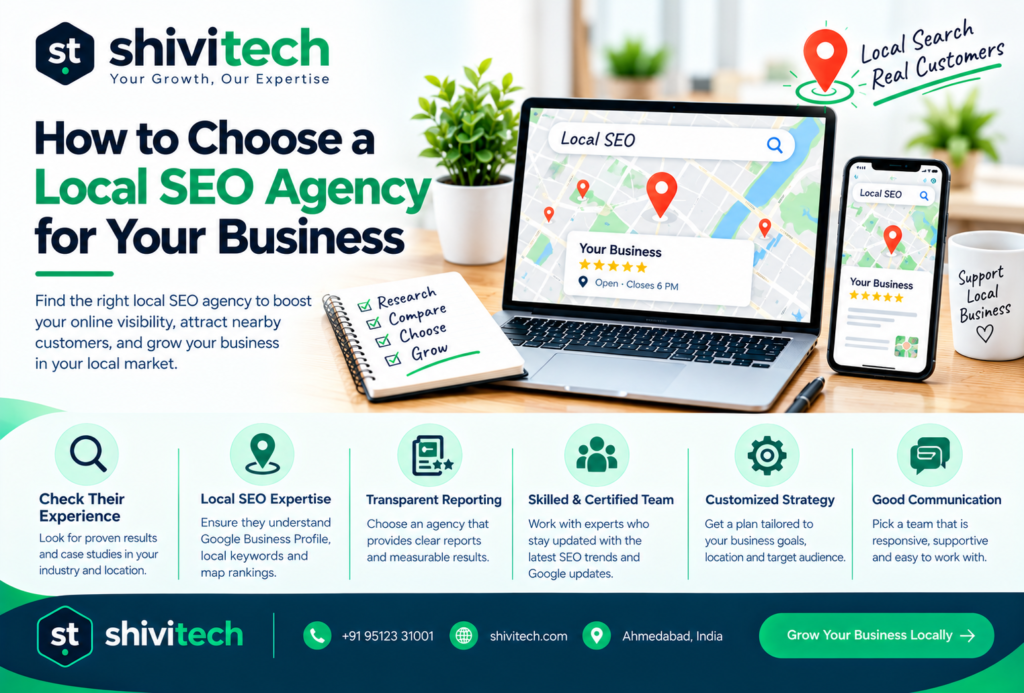
Choosing a local SEO agency can feel harder than it should. Every agency promises more calls, higher map rankings and a flood of “near me” traffic, but the difference between a good partner and a poor one often only shows up months later, after you’ve paid for work that didn’t move the business forward.
This guide is written for business owners who are actively comparing agencies. It explains what a local SEO agency should be doing, the questions to ask before you sign anything, the warning signs of outdated or risky tactics, and what meaningful reporting looks like.
What Does a Local SEO Agency Actually Do?
A local SEO agency improves how a business appears when people search for its services in a specific area, particularly in Google’s map pack (the group of local listings shown with a map) and in local organic results. Its work typically covers five areas:
- Google Business Profile optimization – Setting up and maintaining an accurate, complete profile with the right categories, services, hours, photos and updates.
- Local citations and NAP consistency – Making sure your business name, address and phone number (NAP) are correct and consistent across directories, industry platforms and data sources.
- Geo-targeted content – Creating and improving service and location pages that answer the questions customers in your area actually ask.
- Review generation and management – Building an ethical, repeatable process for earning genuine customer reviews and responding to them.
- Local link building – Earning links and mentions from local organisations, publications, sponsorships, partners and industry associations.
A good agency connects these into one strategy rather than treating each as a separate task, and it ties the work to business outcomes such as calls, bookings, direction requests and enquiries.
Local SEO Agency vs General SEO Agency: What’s the Difference?
A general SEO agency focuses on improving a website’s visibility in organic search, often for national or topic-based keywords. A local SEO agency focuses on visibility for searches with local intent, where the searcher wants a provider nearby.
| Factor | General SEO Agency | Local SEO Agency |
| Primary goal | Organic rankings and traffic | Map pack and local organic visibility |
| Key assets | Website content and backlinks | Website + Google Business Profile + citations + reviews |
| Keywords | Topic and product-based | Service + location and “near me” intent |
| Success metrics | Traffic, rankings, conversions | Calls, direction requests, bookings, local enquiries |
| Link building | Authority-focused, often national | Local relevance, community and industry sources |
Many agencies offer both. What matters is whether the team has hands-on experience with the local-specific parts of the work—Google Business Profile management, citation cleanup, review strategy and map pack tracking—rather than simply applying general SEO methods to a local business.
If your business serves customers nationally or across many regions, a broader approach may fit better. Here are some signs your business needs more than basic SEO.
Questions to Ask a Local SEO Agency Before Hiring
The answers to these questions tell you far more than a sales presentation. Use them in your first calls with any agency you’re considering.
Questions About Google Business Profile Management
- Who will own our Google Business Profile? Your business should always own the profile. The agency should be added as a manager, not the owner.
- What will you change on our profile, and why? Expect specific answers about categories, services, descriptions, photos and posts.
- How do you handle suspensions, duplicate listings or incorrect edits? Experienced agencies have a clear process for these common problems.
- Will you add keywords or locations to our business name? The right answer is no. It goes against Google’s guidelines and can lead to suspension.
- How do you approach reviews? Look for a process built around genuine customers, timely responses and no incentives for positive ratings.
Questions About Reporting and What “Results” Actually Means
- What metrics will you report on each month? Rankings alone aren’t enough. Ask about calls, direction requests, website visits from your profile and enquiries.
- How do you track map pack rankings? Local rankings vary by the searcher’s location. Good agencies track visibility across multiple points in your service area, not from a single location.
- How will we know the work is contributing to revenue? Ask about call tracking, form tracking and connecting enquiries to real business outcomes.
- What work will you complete each month? You should receive a clear list of completed tasks, not just charts.
- What results should we realistically expect, and when? Be wary of anyone who guarantees a specific ranking or timeline.
Questions About Industry Experience
- Have you worked with businesses in our industry? Local SEO for a law firm differs from local SEO for a restaurant or HVAC company.
- What industry-specific platforms and directories do you use? Healthcare, legal and hospitality businesses all have their own important listing sites.
- Are there compliance or advertising rules in our industry you need to follow? This matters especially in healthcare and legal services.
- Can you share examples or case studies from similar businesses? Ask what was done, not only what happened to the numbers.
Signs a Local SEO Agency Is Using Outdated or Risky Tactics
Some tactics that worked years ago no longer help—and some can actively harm your business. Watch for these warning signs:
- Guaranteed rankings. No agency controls Google’s results. Promises of “#1 in the map pack” are a red flag.
- Keyword stuffing in your business name. Adding “Best Dentist Downtown” to your listing name violates Google’s guidelines.
- Fake or incentivised reviews. Buying reviews, writing them internally or offering discounts for five-star ratings can lead to review removal, profile restrictions and lost customer trust.
- Mass citation blasts. Submitting your business to hundreds of low-quality directories adds little value. Accuracy and relevance matter more than volume.
- Doorway location pages. Dozens of near-identical pages that only change the city name offer little value and can weaken your site.
- Virtual offices or fake addresses. Creating listings at locations where you don’t operate can get profiles suspended.
- Agency-owned assets. If the agency owns your profile, website, tracking numbers or domain, leaving them becomes difficult.
- Vague reporting. Reports full of ranking screenshots with no connection to calls or enquiries often hide a lack of meaningful work.
- Long lock-in contracts with no defined deliverables. You should know exactly what you’re paying for.
What Good Local SEO Reporting Should Include
Good reporting shows what was done, what changed, and whether it’s helping the business. A useful monthly report should include:
Google Business Profile performance
- Profile views and how people found you
- Calls, website clicks, direction requests and bookings or messages from the profile
Local visibility
- Map pack rankings for priority keywords across multiple points in your service area
- Local organic rankings for key service and location pages
Website performance
- Traffic from local search to service and location pages
- Form submissions, calls and other conversions
Reviews
- New reviews, average rating and response rate
- Notable feedback trends
Citations and technical work
- Citations created, corrected or cleaned up
- Technical fixes completed on the website
Work completed and next steps
- A clear summary of tasks finished this month
- Priorities for the coming month and why
The best reports focus on vanity metrics less and business metrics more. Impressions and rankings are useful context, but calls, bookings and enquiries tell you whether the work is paying off.
Local SEO for Specific Industries
Local SEO principles are consistent, but priorities shift by industry. An agency with relevant experience will adapt its approach accordingly.
Healthcare
Clinics, dentists, physiotherapists and diagnostic centres rely heavily on accurate, trustworthy information. Priorities include correct practitioner and location details, clear service listings, healthcare-specific directories, and a review process that respects patient privacy—responses should never confirm or discuss patient details. Content should be accurate, clearly written and aligned with any medical advertising rules that apply.
Legal
Law firms compete on high-value, high-intent searches such as “personal injury lawyer near me.” Strong practice area pages, attorney profiles, legal directories, local bar association listings and a thoughtful review strategy all matter. Advertising rules for legal services vary, so claims and testimonials must be handled carefully. Learn more about our approach to law firm marketing and local SEO.
Home Services
HVAC, plumbing, electrical and cleaning businesses often serve customers at their homes rather than at an office. That makes service area configuration, service-specific pages, fast mobile experiences, click-to-call and a steady flow of recent reviews especially important. Emergency and seasonal searches also shape content and profile updates. See how we approach HVAC marketing and local SEO.
Hospitality
Restaurants, cafés and hotels depend on photos, menus, accurate hours (including holiday hours), reservation links and review platforms beyond Google. Recency matters: fresh photos, updated menus and timely review responses help both customers and local visibility.
FAQs
How is local SEO different from regular SEO?
Regular SEO focuses on improving a website’s organic rankings for broad or topic-based searches. Local SEO focuses on visibility for searches with local intent, including the map pack and “near me” results. It relies on additional factors such as Google Business Profile, NAP consistency, local citations and reviews.
How long does local SEO take to show results?
Most businesses begin to see meaningful local SEO results within 4 to 6 months. Some improvements, such as fixing an incomplete Google Business Profile or incorrect business details, can have an effect sooner, while competitive industries and locations may take longer.
Do I need a local SEO agency if I only serve one city?
Not necessarily, but many single-location businesses benefit from one. If you have the time to manage your Google Business Profile, citations, reviews and local content consistently, you can handle the basics yourself. An agency becomes more valuable when competition is strong, visibility is low, or you don’t have the time or expertise to do the work well.
What is a Google Business Profile and why does it matter?
A Google Business Profile is a free listing that shows your business in Google Search and Google Maps, including your address, hours, phone number, services, photos and reviews. It’s often the first thing local customers see, and it directly influences whether they call, visit or choose a competitor.
Conclusion
The right local SEO agency should be able to explain exactly what it will do, why it matters for your business, and how it will measure success in terms that connect to real customers. Ask direct questions, watch for risky shortcuts, and choose a partner whose reporting focuses on calls, bookings and enquiries, not just rankings.
Shivi Tech works with healthcare providers, law firms, home services companies and hospitality businesses to build stronger local visibility through Google Business Profile optimization, citation management, review strategy and geo-targeted content. Learn more about our Local SEO services.
Want to know where your business stands in local search? Get a free local SEO audit covering your Google Business Profile, citations, reviews and local visibility. Request Your Free Local SEO Audit