





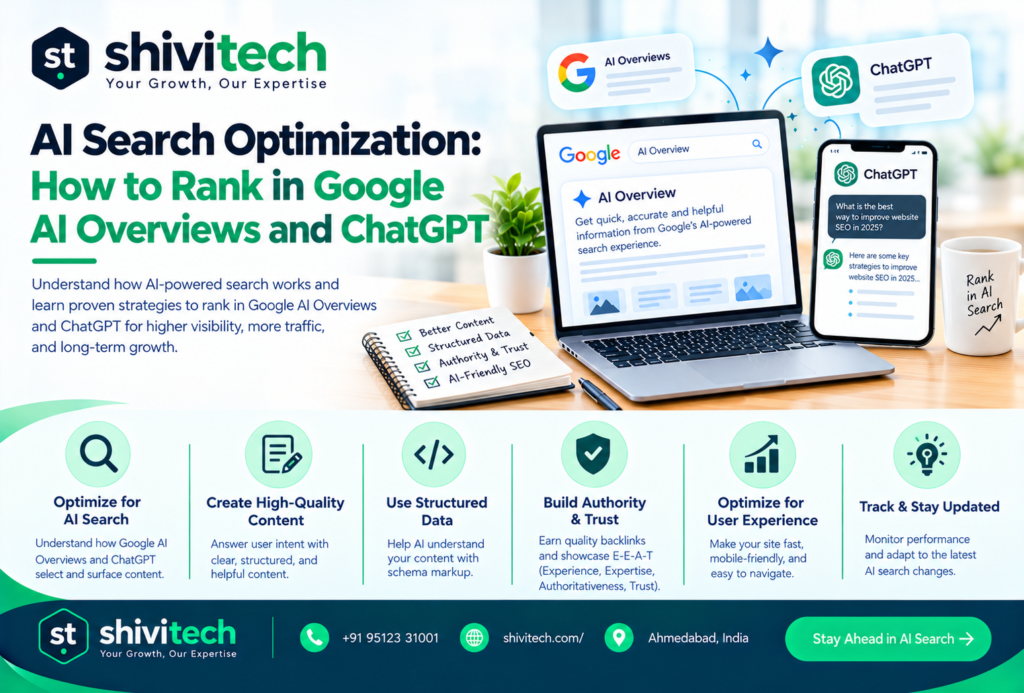
AI search optimization is the practice of structuring your content, brand and website so that AI-powered search tools such as Google AI Overviews, ChatGPT, Gemini, Microsoft Copilot and Perplexity can understand it, trust it and cite it in their answers. Traditional SEO aims to earn a ranking position in a list of links. AI search optimization aims to earn a place inside the answer itself.
That shift matters because more people now get answers without clicking through ten blue links. They ask a question, read a generated summary, and sometimes act on it right there. If your business isn’t part of that summary, you may be invisible at the moment a customer is deciding who to trust.
This guide explains how AI search optimization works, how the main platforms find and cite information, what to change in your content, which mistakes keep pages out of AI answers, and how to measure whether it’s working. It’s also written the way it recommends: a direct answer first, clear structure, and short, quotable answers in the FAQ.
If you’d rather have a team handle it, take a look at our GEO and AI SEO services.
What Is AI Search Optimization?
AI search optimization is the work of making your content easy for AI systems to retrieve, interpret and quote. It builds on traditional SEO rather than replacing it. A page still needs to be crawlable, fast, relevant and trustworthy. The difference is in what happens next.
In classic search, a ranking algorithm sorts pages and the user chooses one. In AI search, a system retrieves relevant passages from many sources, then a language model composes an answer, often with citations. Your goal is to be one of the sources it pulls from and credits.
That changes what “good content” looks like. AI systems favor pages that state facts plainly, define terms clearly, describe how things relate to each other, and are easy to extract a single accurate answer from. Vague, padded or purely promotional pages tend to get passed over.
You’ll see several labels for this work, which brings us to the terminology.
AEO, GEO, and Traditional SEO: What’s the Difference?
The industry hasn’t settled on one name. Answer engine optimization (AEO) focuses on being the direct answer to a question, whether in a featured snippet, a voice assistant or an AI summary. Generative engine optimization (GEO) focuses on being cited or referenced inside content generated by large language models. Traditional SEO focuses on ranking pages in a list of search results.
In practice they overlap heavily, and the same good habits support all three. Here’s how they compare:
| Traditional SEO | AEO | GEO | |
| Goal | Rank pages high in search results and earn clicks | Be the direct answer to a specific question | Be cited or mentioned in AI-generated responses |
| Target engine | Google and Bing results pages | Featured snippets, voice assistants, AI summaries | ChatGPT, Gemini, Copilot, Perplexity, Google AI Overviews |
| Primary technique | Keywords, backlinks, technical health, content quality | Direct-answer formatting, FAQ structure, structured data | Entity clarity, authoritative factual content, brand mentions across the web |
| Measurement | Rankings, organic traffic, conversions | Snippet and answer appearances | Citations, brand mentions, referral traffic from AI tools |
The takeaway: you don’t have to choose. Strong SEO fundamentals get you into the pool of sources; AEO and GEO practices make you the source that gets chosen.
How Google AI Overviews Choose What to Show
Google AI Overviews are AI-generated summaries that appear at the top of some search results, with links to the sources they drew from. Google has said that there’s no special markup or secret technique required to appear in them. The page needs to be indexed and eligible to be shown with a snippet, and the same fundamentals that support ordinary search apply.
What we can say with reasonable confidence is that pages are more likely to be useful to an AI Overview when they:
- Directly answer the question being asked, ideally early in the page
- Come from a site that demonstrates real expertise and trustworthiness
- Are clearly organized, with headings that match how people phrase questions
- Cover a topic thoroughly enough to support a well-rounded summary
- Are technically accessible, meaning crawlable, indexable and not blocked from snippets
AI Overviews often draw on pages that rank well in traditional results, but they don’t only use the top result, and the sources shown can vary by query. Google’s systems and features also change regularly, so treat any rule of thumb as a starting point and check Google’s current documentation.
How ChatGPT, Gemini, Copilot, and Perplexity Find and Cite Information
These tools don’t all work the same way, but many rely on a similar idea: retrieval-augmented generation, often shortened to RAG. In simple terms, the system searches for relevant material, pulls in passages from the pages it finds, and uses them to compose an answer, often linking to its sources.
- ChatGPT can use a search function to pull in current web results and cite them, in addition to what it learned during training.
- Gemini is connected to Google’s search ecosystem and can draw on web results.
- Microsoft Copilot is built around Microsoft’s Bing search index.
- Perplexity is designed as an answer engine that searches the web in real time and shows numbered citations.
Exact data sources and behavior differ by product and change over time, so it’s worth testing each platform directly rather than assuming they’re identical.
How these tools differ from a traditional search crawler
A traditional crawler indexes a page and ranks it as a whole. AI retrieval systems tend to work at the passage level: they look for the specific paragraph, table or list that answers the question. They also care about whether information is consistent across sources and whether the entity behind it, such as a company, product or person, is clearly identified.
Another practical difference is access. Several AI tools use their own crawlers or fetch tools, so if your robots.txt file or firewall blocks them, you may be excluding yourself from citations without realizing it. Whether you want to allow them is a business decision, but it should be a deliberate one.
Why structured, factual content gets cited more often
An AI system needs to extract an answer it can state with confidence. Content that is specific, consistent and clearly structured makes that easy. Content that buries the answer in marketing language, or that contradicts itself across pages, makes it risky.
There are no guarantees here, but the logic is simple. Clear definitions, short direct answers, labelled lists and tables, and verifiable facts give retrieval systems clean material to work with.
How to Optimize Content for AI Search
At Shivi Tech, our approach to AI search optimization combines structured content, entity optimization and search intent alignment. We also look at the language a business already uses on its own site, such as its FAQs, and make sure the wording is consistent and answer-ready across pages. Here are the core practices.
Direct-answer introductions
Open each page or section with a one- or two-sentence answer to the main question, then expand. If someone asks “what is AI search optimization,” the first sentence of your page should say what it is. This helps readers, earns featured snippets, and gives AI systems a passage they can lift cleanly.
A simple pattern: a question-style heading, a direct answer in the first sentence, then context, examples and nuance.
Clear entity relationships and semantic structure
AI systems think in entities: companies, products, services, places, people and the relationships between them. Make yours unambiguous.
- State clearly who you are, what you offer, who you serve and where.
- Use consistent naming for your brand, services and products across your site and profiles.
- Connect related topics with sensible internal links and descriptive anchor text.
- Cover a topic as a connected set of pages, not isolated posts. For example, our guidance on how we approach local SEO links naturally to this topic, since local and AI search results increasingly overlap in map results and AI answers.
This is the practical side of entity-based SEO and semantic SEO: helping machines understand not just your keywords, but what your business is and how it relates to everything else on the page.
Structured data and FAQ formatting
Structured data (schema markup) labels the content on your page so machines can interpret it more reliably. Depending on your site, relevant types include Organization, LocalBusiness, Product, Article, Review and FAQPage. Keep the markup accurate and matched to visible page content.
FAQ sections are valuable for another reason: they mirror how people ask questions. Write each answer as a short, standalone response that makes sense if quoted on its own. Note that Google has limited how often FAQ rich results appear in standard search, so use FAQs for clarity and answer-readiness rather than only for rich results.
For online stores, this also means product pages with clear specifications, consistent pricing information and structured data. If you’re building or rebuilding a store, Shopify development with these fundamentals in mind helps your catalog stay clean and machine-readable, and our guide to ecommerce SEO built for how people search today covers the technical checklist in more depth.
Common Mistakes That Keep Content Out of AI Overviews
- Burying the answer. If the answer to the question takes five paragraphs of preamble, a retrieval system may skip to a page that gets to the point.
- Thin or generic content. Pages that repeat what every other site says give an AI system no reason to choose yours.
- Blocking crawlers by accident. Overly strict robots.txt rules, noindex tags or snippet restrictions can remove you from consideration.
- Inconsistent facts. Different opening hours, service descriptions or pricing across pages and profiles weaken trust.
- Ignoring entity signals. If it isn’t clear who you are and what you do, systems may attribute your expertise elsewhere or not at all.
- Unstructured walls of text. Without clear headings, lists and tables, there are few clean passages to extract.
- Marketing language over facts. Superlatives without substance rarely make it into an answer.
- Treating it as a one-off. AI search products change frequently, and content needs ongoing review.
- Expecting guarantees. No one can guarantee a citation or a position inside an AI answer. Be wary of anyone who does.
If you work with partners, it’s also worth asking whether they’ve built this into their delivery. Agencies evaluating vendors increasingly ask about it, and our checklist for white label SEO services that include AI search optimization covers what to look for.
How to Measure AI Search Visibility
Measurement is the part most guides skip, and it’s still imperfect. There’s no single dashboard that tells you everything, but you can build a useful picture with a few methods.
- Test prompts manually. Make a list of 20 to 30 questions your customers actually ask. Run them on Google (looking for AI Overviews), ChatGPT, Gemini, Copilot and Perplexity, and record whether your brand is mentioned, whether your site is cited, and which competitors appear. Repeat monthly, since answers vary between runs.
- Check referral traffic. In your analytics tool, look at referral sources for visits from AI platforms such as chatgpt.com or perplexity.ai. Volumes may be small today, but the trend is useful.
- Use Search Console. Google has said that clicks and impressions from AI features are included in the Search Console performance report for web search. You can’t isolate them as neatly as a standard ranking, but you can watch changes in impressions for your question-style queries.
- Track brand mentions and branded search. Growth in branded searches and unlinked mentions can signal growing visibility, even where no click occurs.
- Consider specialist tools. A growing number of platforms track AI citations and share of voice. Evaluate them carefully, since methods and accuracy vary.
Look for patterns over time rather than reacting to a single answer. AI responses are variable, so one missing mention doesn’t mean you’ve failed, and one appearance doesn’t mean you’ve won.
FAQs
Is AI search optimization the same as traditional SEO?
No, but they’re closely related. Traditional SEO focuses on ranking pages in search results, while AI search optimization focuses on being understood and cited inside AI-generated answers. Strong SEO fundamentals support both, so one builds on the other.
Can a website appear in ChatGPT answers without ranking on Google?
Yes, it’s possible. ChatGPT and similar tools retrieve information from their own sources and search partners, so a page can be cited without holding a top Google ranking. However, pages that are authoritative, clearly structured and widely referenced tend to have an advantage across platforms.
Do I need to change my content if I already rank well in Google?
Probably some, but not a rewrite. Ranking well means your fundamentals are working. To improve AI visibility, add direct-answer introductions, clearer headings, consistent entity information, structured data and short FAQ answers, and make sure AI crawlers aren’t blocked.
How do I know if my content is being cited by AI search engines?
Test your target questions manually across ChatGPT, Gemini, Copilot, Perplexity and Google, and record whether your brand or site appears. Supplement this with AI referral traffic in your analytics, Search Console data and, if needed, a dedicated AI visibility tracking tool.
Conclusion
AI search optimization isn’t a replacement for SEO. It’s the next layer on top of it. The businesses most likely to be cited by Google AI Overviews, ChatGPT, Gemini, Copilot and Perplexity are the ones that answer questions directly, describe themselves clearly, keep their facts consistent, and structure content so machines can read it as easily as people can.
There are no guarantees in this space, and the platforms keep evolving. What you can do is build content that is genuinely useful and easy to extract, then measure and refine. If you’d like help with that, explore our GEO and AI SEO services or our broader SEO & Search Growth services.
Want your business to show up in AI answers? Talk to Shivi Tech about an AI search optimization plan built around your content, your customers and the questions they’re asking.